Project Description
Sermon: “Awake in the Dark” (5/5)
Sermon Series: Children of the Light
Scripture: 1 Thessalonians 5:1 – 11
Pastor Rushan preached this sermon on November 15, 2026 at the 7 AM service (Honolulu) and the worship service at Central Union Windward.
~ ~ ~ ~ ~
By Rev. Rushan Sinnaduray
Welcome to the fifth and final week of our fall series, “Children of the Light”. For the past month, we have been diving deep into the Apostle Paul’s First Letter to the Thessalonians. Now, I know that life is incredibly busy. We have folks traveling, kids playing weekend sports, and schedules that pull us in a thousand different directions. So if you are joining us for the first time today, or if you missed the earlier parts of this series, please take a deep breath and know that you are exactly where you need to be. You haven’t missed the boat.
To bring you right up to speed, we are studying what biblical historians tell us is likely the very earliest surviving letter written by Paul, penned around the year 50 CE. We are not reading a cozy theological textbook drafted in a quiet ivory tower; we are reading a survival manual written by a pastor on the run. Paul wrote this letter to a young, terrified, and deeply anxious house church that was facing intense persecution and desperately wondering what the future held for them. Over the past four weeks, we have explored how this brave little community was called to have a faith that rings out into the streets, how they were challenged to drop their religious masks and share their very selves with one another, and how they were taught to grieve their painful losses with a stubborn, defiant hope.
Today, we arrive at the climax of Paul’s letter. In chapter five, Paul is writing about what it means to be awake in the dark.
We all know what it feels like to be awake in the dark. Usually, it happens around 3:00 in the morning. You are staring at the ceiling. The house is completely quiet, but your brain is running at a hundred miles an hour. You start by worrying about something mundane, like whether you remembered to turn off the stove. Then you remember an awkward conversation you had in 2014. Before you know it, you are staring at the glowing rectangle of your phone, doom-scrolling through the forty-seventh article about how the world is officially falling apart, marinating in outrage, and wondering if you should just get up, eat an entire sleeve of Oreos, and surrender to the chaos.
Anxiety seems to be the default operating system of our modern society. We live overstimulated, exhausted, and deeply confused. We worry about our families, our economy, and the soul of our society. Fear thrives in the shadows.
Many years ago at a previous church in Connecticut, I took our youth group on a week-long mission trip to inner-city Philadelphia. It was a very diverse group of young people and adult chaperones. On the first day we were given our project. We found ourselves standing in an abandoned, overgrown piece of land right in the heart of that inner-city neighborhood. It was a literal place of shadows – a dumping ground for broken glass, discarded needles and broken down furniture that everyone walked past and ignored. The neighborhood felt forgotten, and the people living around it were exhausted by the decay. Our little group of young people didn’t just pray for the lot from the comfort of a sanctuary; they showed up at 7:00 AM the next day with shovels, work gloves, and a fierce determination. Sweating in the dirt, pulling out rusted metal, and turning over the soil, we were able to transform that blighted lot into what eventually became a thriving community garden and an oasis in the middle of the city. But here is the miracle: we didn’t just change the landscape and the neighborhood. The act of doing the hard, messy work together fundamentally changed us.
It was a profound experience of what the New Testament calls metanoia—a Greek word we often flatten into the English word “repentance,” but which truly means a radical, systemic transformation of one’s entire mind, heart, and way of living. We moved from isolated, anxious individuals into a deeply connected, transformed community. We realized that personal transformation is inextricably linked to communal transformation. You cannot heal in a vacuum.
The Roman Empire knew exactly how to keep people isolated and afraid. To fully grasp what Paul is doing in chapter five, we have to look closely at the reality of the ancient Mediterranean world. Thessalonica was a fiercely loyal Roman colony. It was a bustling, hyper-nationalistic trade city that plastered imperial propaganda across every public wall. The ultimate slogan of the empire was that Caesar is Lord, and that Caesar alone brings peace. But it was a false peace. It was peace through military domination, peace through the edge of a sword, and peace through the crush of a boot on the neck.
When Paul writes in verse three, “When they say, ‘There is peace and security,’ then sudden destruction will come upon them,” he is not making a generic spiritual point. He is directly quoting the imperial propaganda of Rome. He is calling out the empire’s bluff. Paul knows that any society built on fear, division, and the oppression of the vulnerable is a house of cards waiting to collapse.
Paul steps into that fear-driven community and proclaims a different kind of king—a crucified peasant carpenter whose power is poured out in love, not enforced by legions. And then, he looks at these marginalized, anxious believers who are huddled in the shadows of the empire, and he declares something fiercely radical. He says, “But you, beloved, are not in darkness… for you are all children of light and children of the day; we do not belong to the night or to the darkness”.
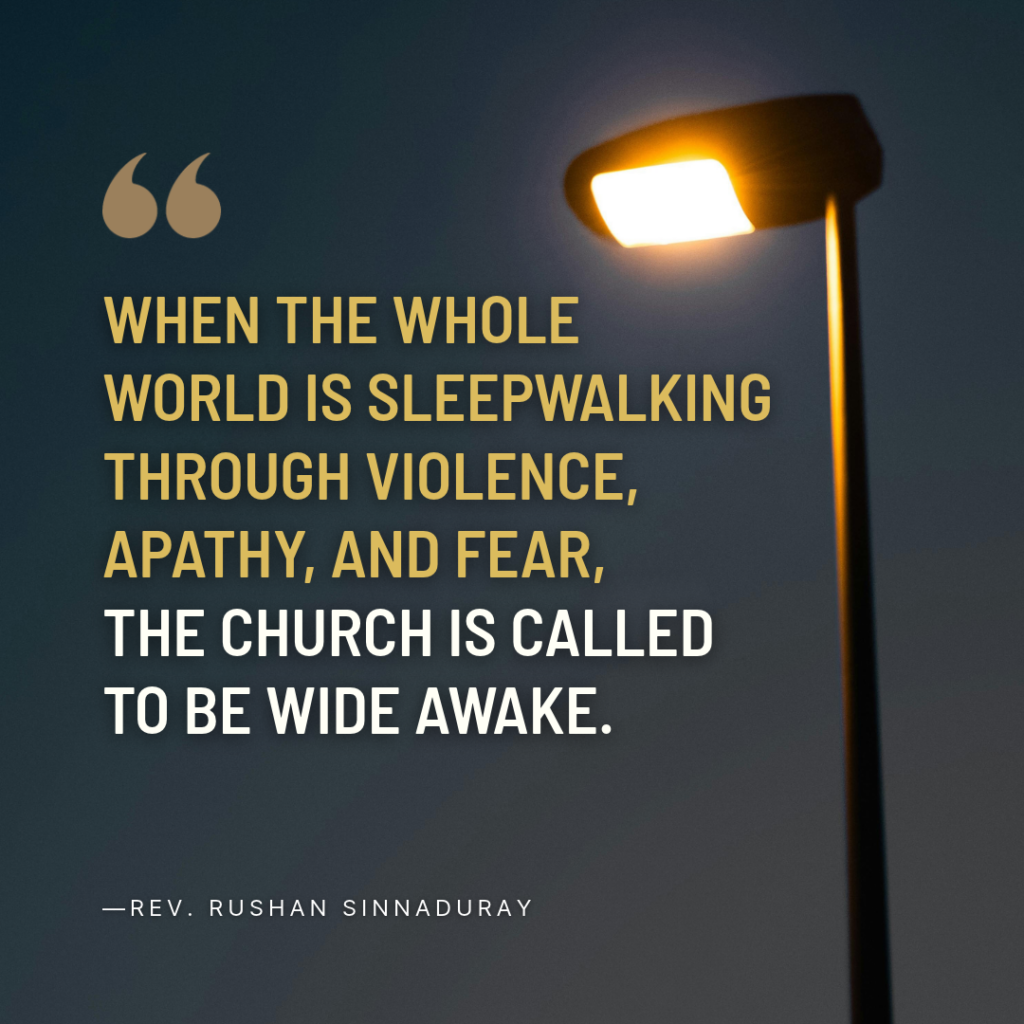
He is telling them to wake up. When the whole world is sleepwalking through violence, apathy, and fear, the church is called to be wide awake.
But waking up in the dark requires a very specific kind of spiritual defiance. It requires a hope that has teeth. The brilliant progressive author and activist Rebecca Solnit frames this beautifully in her book Hope in the Dark. She writes, “Hope is not a lottery ticket you can sit on the sofa and clutch, feeling lucky. It is an axe you break down doors with in an emergency”.
Paul is handing the Thessalonians an axe. He tells them in verse eight to stay sober and put on the breastplate of faith and love, and for a helmet the hope of salvation. He is equipping them for the daytime, even when the world around them feels like midnight. And he tells them exactly what to do with that hope: “Therefore encourage one another and build up each other, as indeed you are doing”.
Franciscan priest and spiritual thinker Richard Rohr observes, “Transformed people transform people.” If our faith is merely a private, intellectual exercise, it is completely useless to a bleeding world. Authentic ministry requires genuine vulnerability. It means leaving the mess on your living room floor, dropping the illusion of perfection, and inviting people into the glorious reality of actual, flesh-and-blood human connection. It means actively dismantling the systems that oppress our neighbors and doing the sweaty, collaborative work of justice to transform our communities from the ground up.
The progressive civil rights leader and Sikh activist Valarie Kaur often asks a piercing question about the painful, chaotic state of our modern society. She asks, “What if this darkness is not the darkness of the tomb, but the darkness of the womb? What if our America is not dead, but a country that is waiting to be born?”.
That is the ultimate posture of being awake in the dark. It means looking at the mess, looking at the grief, looking at the deep fractures in our society, and refusing to believe it is a tomb. It is a womb. God is laboring to birth something new. And God is calling the church to be the midwives.
We are the church here and now. Honolulu does not need a community of perfect, polished marble statues. Honolulu does not need a VIP club for the morally flawless. Honolulu needs a people who refuse to hit the snooze button on justice. We need a congregation that refuses to sleepwalk through our faith. We refuse to let cynicism win.
So let us be dangerously hopeful.
When society creates outcasts, let us offer open arms.
When the world thrives on division, let us double down on grace.
When the shadows try to close in, let our faith ring out.
We are not victims of the night; we are children of the dawn. We belong to the day. Let us carry the light forward, build each other up, and walk this bold and beautiful way together.
May you be awake. May you be courageous. And may you be deeply, stubbornly full of hope. Amen.
~ ~ ~
View the previous sermons in this sermon series