
Project Description
Sermon: “Grieving with Hope” (4/5)
Sermon Series: Children of the Light
Scripture: 1 Thessalonians 4:13-18
Pastor Rushan preached this sermon on November 8, 2026 at the 7 AM service (Honolulu) and the worship service at Central Union Windward.
~ ~ ~ ~ ~
By Rev. Rushan Sinnaduray
Welcome to week four of our fall series, “Children of the Light”. If you are joining us for the first time today, or if you missed a few Sundays, let me bring you right into the fold.
For the last month, we have been tracing Paul’s First Letter to the Thessalonians. Biblical scholars tell us this is likely the very earliest letter in our New Testament. It was written to a fragile, courageous little house church trying to figure out how to live with authentic faith in a deeply fractured empire.
We started in week one by looking at a “faith that rings out”. We talked about a stubborn, active conviction that reverberates like thunder through the neighborhood. In week two, we talked about “sharing our very selves”. We talked about dropping our polished spiritual facades and offering genuine, vulnerable presence to one another. Last Sunday, we paused for All Saints’ Day to remind ourselves of our “family resemblance”. We remembered that we are children of God right now. We are not marble statues on pedestals. We are messy human beings called to reflect the tangible compassion of Christ.
And that brings us to today. Today we are looking at the fourth chapter of First Thessalonians.
To understand what Paul is writing in chapter four, we have to clear away centuries of bad theology and apocalyptic pop fiction. For generations, traditionalist systems have snatched these verses—with their vivid imagery of trumpets, clouds, and rising into the air—and twisted them into the modern doctrine of the “rapture”. They turned this text into a cosmic escape hatch. They spun terrifying tales about faithful believers vanishing into thin air while the earth burns behind them.
That is an awful misinterpretation of the text.
Paul was not writing a script for an end-times thriller. He was writing a pastoral love letter to an aching community. These believers lived in Thessalonica under the heavy, violent shadow of Roman imperial power. They had embraced this radical Good News expecting that Christ’s kingdom of peace and justice would arrive in fullness during their lifetimes. But weeks and months had rolled on. And something unexpected and heartbreaking happened. Their friends, their parents, and their siblings in the faith started dying.
In the ancient Greco-Roman world, the prevailing cultural consensus on death was bleak and hopeless. Pagans of that era often inscribed tombstones with a cynical Latin phrase that roughly translates to: “I was not; I was; I am not; I do not care.” Death was viewed as a cold, permanent wall where existence simply evaporated into oblivion.
The Thessalonians were terrified. They worried that their loved ones who had died had somehow missed out on Christ’s glorious renewal. They were drowning in confusion. And into that overwhelming silence, Paul speaks with profound pastoral tenderness:
“We do not want you to be uninformed, brothers and sisters, about those who have died, so that you may not grieve as others do who have no hope.”
Notice what Paul does not say. He does not say, “Do not grieve.”
He doesn’t tell them to paste on a fake religious smile. He doesn’t tell them to suppress their tears or recite shallow clichés. Christianity is never a call to emotional numbness. Grief is the sacred tax we pay on love. When we lose someone we cherish, our hearts break because the love was real. Paul does not forbid grief. He anchors it. He says: Do not grieve as those who have no hope.
And what is that hope? When Paul uses the imagery of meeting the Lord “in the air”, he isn’t describing an evacuation off planet Earth. In the ancient world, when an emperor or dignitary visited a city, the citizens would go out beyond the city gates to greet them in the open air. They would welcome the king and joyfully escort him back into their city. Paul uses that exact imperial metaphor to subvert Caesar! He is saying that Jesus is the true Lord. When his renewal comes, heaven meets earth. God does not abandon the dust of this creation. God redeems it. Love wins over the grave. Death is not a period. It is only a comma.
That brings us directly into the thick, exhausted air we are all breathing right here in Honolulu this second Sunday of November.
Just five days ago, our nation voted in the mid-term elections. Leading up to Tuesday, the airwaves, our mailboxes, and our screens were choked with apocalyptic rhetoric. We were told by every talking head and social media algorithm that if the other side gained an inch, the world was ending tomorrow. I don’t know about you, but by Tuesday, my blood pressure was so high I was ready to unplug my Wi-Fi and move to an island in the middle of the Pacific. Which, I realize, we already live on. I was ready to communicate exclusively via carrier pigeon.
Yet, here we are. The sun still came up on Wednesday morning. The trades are still blowing. We are gathered in this room, worshipping together and looking each other in the eye.
Over the past few days, as the election results settled across our state and our country, many people finally exhaled. In so many races, we caught glimpses of genuine hope. We saw voices for decency, equity, and human dignity being affirmed. We saw communities standing up to say that compassion matters and that the vulnerable must be protected.
Texas Senator James Talarico, a former middle school teacher and a Seminarian who has become a powerful voice for progressive faith, captured this perfectly in his victory speech. Looking out at a weary but resilient crowd, he declared, “A little bit of hope is a dangerous thing.”
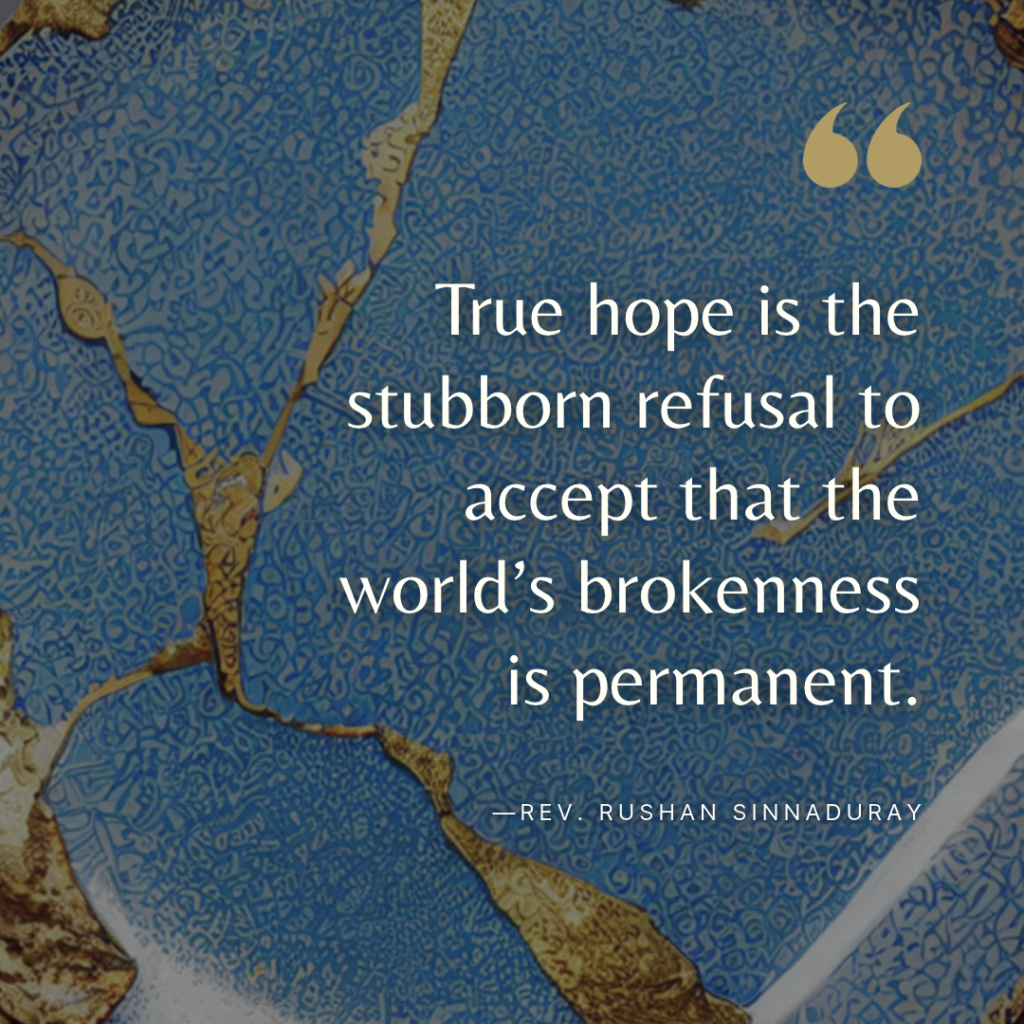
He is exactly right. A little bit of hope is a dangerous thing to the empire. It is a dangerous thing to the billionaires, the fear-mongers, and the doom-scrollers. Because true hope is the stubborn refusal to accept that the world’s brokenness is permanent.
It is good and right to celebrate that hope. Whenever our civic life reflects greater equity or care for the poor, we see ripples of God’s dream for the world. As the brilliant theologian Cornel West famously said, “Justice is what love looks like in public.”
And yet, we are also reminded that our ultimate hope cannot be inaugurated by an election. Nor can it ever be repealed by one. If our hope is tied exclusively to who holds the gavel, who controls a committee, or what the stock market does on Monday morning, we will constantly ping-pong between euphoria and despair.
Paul’s word to the Thessalonians reminds us that Christian hope is fundamentally different. It is not blind optimism. Optimism looks at the circumstances and crosses its fingers that things turn out okay. Hope looks the worst reality square in the face—even the cold reality of the grave—and stubbornly insists that God’s resurrecting love is stronger.
As the late author Rachel Held Evans often reminded us, faith isn’t about having everything figured out; it’s about holding on to the story of Jesus when the rest of the world tells you a different story. Hope is not the absence of loss. Hope is the presence of an unwavering promise.
So, what does it look like for us to be a dangerously hopeful people today?
It means we carry that stubborn hope into every corner of our island.
When our neighbors are stressed over the skyrocketing cost of groceries, we don’t offer cynicism. We offer tangible, sweaty, flesh-and-blood generosity.
When someone in our circle is walking through the valley of the shadow of death, we don’t give them empty religious platitudes. We don’t awkwardly avoid eye contact with them in the produce aisle at Foodland. We sit with them in the dirt. We hold their hands, and we hold hope for them when their own hands are too tired to carry it.
When the political temperature threatens to alienate our families, we refuse to treat human beings as partisan enemies.
We are not people stranded in the dark. We are people who know how the story ends. God’s final word over humanity is not death. God’s final word is not division. God’s final word is not decay. God’s final word is resurrection!
So let us weep when our hearts are broken. But let us weep with hope.
Let us rejoice in every step toward justice. But let our anchor go deeper than politics.
Let us stand beside the open graves of life and declare that love cannot be conquered.
When the world trades in despair, we cultivate hope.
When the culture breeds fear, we practice courage.
When the shadows lengthen, we kindle the blazing, defiant light.
We are not victims of the night. We are children of the dawn.
Therefore, let us encourage one another with these words.
Amen.
~ ~ ~
View the previous sermons in this sermon series